The AI Stock Selloff Hit Your Money Transfer Too. Here's How.
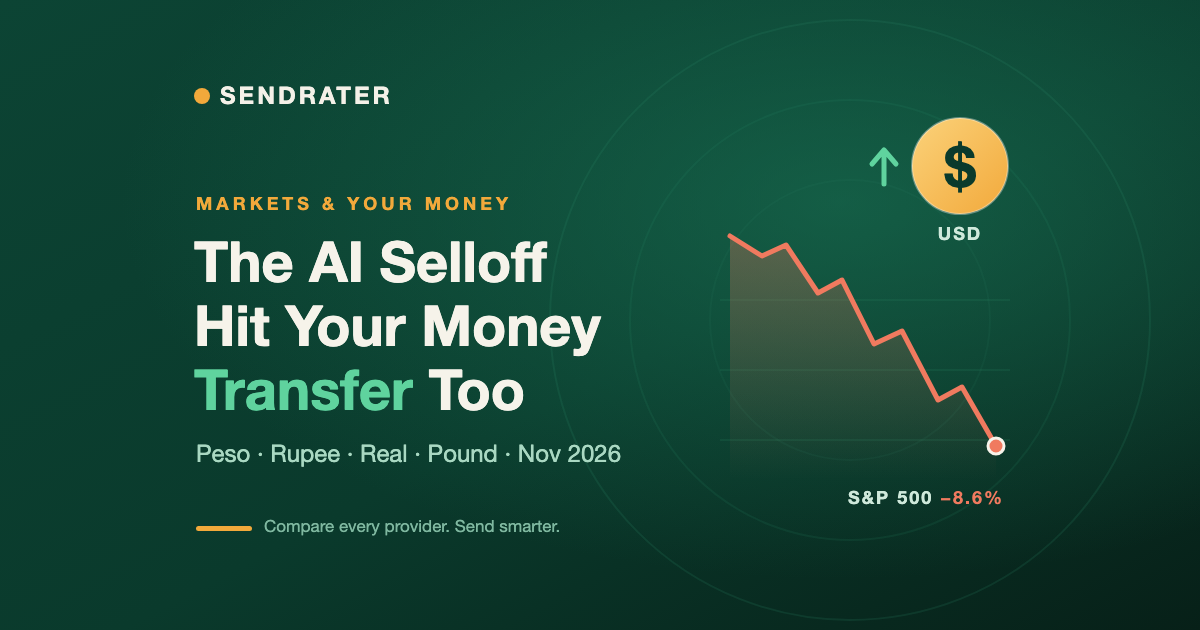
Wall Street just had its worst week in years. Between November 16 and November 20, 2026, the S&P 500 fell 8.6%, the Dow dropped 8% — its worst week since March 2020 — and the Nasdaq lost about 10%. You may not own a single share of Nvidia, but if you send money abroad, this selloff already reached you. Not through your portfolio, but through the exchange rate on your next transfer.
Here's what happened, why a stock market rout moves currencies, and what it has done to the corridors we track — using Sendrater's own rate data as of November 21, 2026.
What happened in the markets
The trigger was AI. After two years of AI-driven gains, investors turned on the trade all at once. Anthropic's much-watched IPO jumped 17% on its first day of trading on Thursday, November 19, then fell 8.5% the next day as the selloff deepened. Chip stocks led the fall: on Friday alone Nvidia lost about 14%, AMD more than 13% and Micron almost 14%, according to CNBC. By Friday's close the S&P 500 (6,910) and the Dow (48,147) were both in correction territory, 10% below their records, and the Nasdaq had wiped out its gains for the year.
It wasn't only Wall Street. South Korea's Kospi fell 5.2% on Friday, and Taiwan's main index had its worst week since 1997. "This is not just a valuation-driven correction. It's becoming broader," Massimo Santicchia of Procyon told CNBC.
Why a stock selloff moves your exchange rate
Two forces hit currencies at the same time.
1. Investors ran to the dollar. When stocks fall hard, big investors pull money out of riskier assets — including emerging-market currencies — and park it in US dollars and US Treasuries. Bank of America counted $7.5 billion of outflows from emerging-market debt funds in the week to November 18, and MSCI's emerging-market currency index fell for a fourth straight week.
2. The Fed is still expected to raise rates. Hot October inflation data on November 10 locked in expectations for a rate hike at the Fed's December 8–9 meeting, and Governor Christopher Waller said a bigger, half-point hike should be considered. Higher US rates make the dollar more attractive to hold. The Dollar Index climbed to around 103.9 — its strongest level since early April 2025 — and was on track for a fourth weekly gain, Reuters reported. ING's Chris Turner summed it up: "For FX, that means a continued strong dollar and continued pressure on popular carry trades."
For senders, a stronger dollar is usually good news if you send from the US and bad news if you send from almost anywhere else. But "usually" is doing a lot of work in that sentence — the effect is very different from one corridor to the next.
What actually moved on the corridors we track
Here's how the mid-market rate for $1 changed over the last month, from October 20 to November 21, 2026, based on Sendrater's own rate logs:
| Currency | Oct 20 | Nov 21 | Change | For a US sender |
|---|---|---|---|---|
| Brazilian real (BRL) | 5.03 | 5.95 | +18.3% | Much more per dollar |
| Colombian peso (COP) | 3,167 | 3,428 | +8.2% | More per dollar |
| South African rand (ZAR) | 16.41 | 17.61 | +7.3% | More per dollar |
| Mexican peso (MXN) | 18.43 | 19.16 | +3.9% | More per dollar |
| Euro (EUR) | 0.891 | 0.912 | +2.3% | More per dollar |
| Nigerian naira (NGN) | 1,329 | 1,355 | +1.9% | Slightly more |
| Philippine peso (PHP) | 63.08 | 64.02 | +1.5% | Slightly more |
| Kenyan shilling (KES) | 129.86 | 130.08 | +0.2% | No real change |
| Guatemalan quetzal (GTQ) | 7.64 | 7.63 | -0.1% | No real change |
| Pakistani rupee (PKR) | 276.73 | 276.00 | -0.3% | No real change |
| Indian rupee (INR) | 94.84 | 92.67 | -2.3% | Less per dollar |
Three very different stories are hiding in that table.
Free-floating emerging-market currencies fell. The Mexican peso is the clearest example of the selloff at work. It lost about 3.3% in a single week, breaking through 19 per dollar for the first time since June 2025, as investors dumped riskier currencies and the gap between US and Mexican interest rates narrowed. The rand and the Colombian peso followed the same pattern. Brazil is a special case: most of the real's slide came from the October 25 election, when Lula's surprise re-election knocked the currency down around 11% in a single day. The global selloff simply added to it.
Managed currencies barely moved. The Guatemalan quetzal, Kenyan shilling and Pakistani rupee are tightly managed by their central banks, so a week of chaos on Wall Street changed almost nothing. If you send to these countries, the market headlines are close to irrelevant for you.
The Indian rupee went the other way. While most currencies weakened, the rupee had its best week of 2026 and reached a seven-month high. Foreign investors kept buying Indian stocks, cheaper oil eased pressure on India's import bill, and the Reserve Bank of India let the rupee rise rather than stepping in. Good news for families in India holding rupees, but a US sender gets about 2.3% fewer rupees per dollar than a month ago.
Sending from the UK? The picture flips
The same dollar strength that helps US senders hurts almost everyone else. The pound fell to near a one-year low against the dollar, and GBP/USD dropped from 1.335 to 1.308 over the month. That weakness carries through to most UK corridors:
| Corridor | Oct 20 | Nov 21 | Change |
|---|---|---|---|
| £1 → Indian rupee | 126.63 | 121.22 | -4.3% |
| £1 → Pakistani rupee | 369.50 | 361.02 | -2.3% |
| £1 → US dollar | 1.335 | 1.308 | -2.0% |
| £1 → Kenyan shilling | 173.40 | 170.15 | -1.9% |
| £1 → Philippine peso | 84.23 | 83.74 | -0.6% |
| £1 → Nigerian naira | 1,775 | 1,772 | -0.2% |
UK-to-India senders got hit twice: a weaker pound and a stronger rupee. At the mid-market rate, £100 bought about ₹12,663 on October 20. Today it buys about ₹12,122 — roughly ₹540 less.
That sounds painful, and it is. But look at what the choice of provider is worth on the same corridor, today:
Sending £100 from the UK to India (November 21, 2026):
| Provider | Rate (INR per £1) | Fee | Recipient gets |
|---|---|---|---|
| WorldRemit | 125.08 | £0.00 | ₹12,508 |
| Nala | 121.58 | £0.00 | ₹12,158 |
| Wise | 121.31 | £1.04 | ₹12,005 |
| TapTapSend | 120.00 | £0.00 | ₹12,000 |
| Remitly | 120.99 | £1.99 | ₹11,858 |
| Barclays | 118.02 | £0.00 | ₹11,802 |
| HSBC | 116.73 | £5.00 | ₹11,089 |
| NatWest | 117.88 | £15.00 | ₹10,020 |
WorldRemit is currently quoting above the mid-market rate, which usually means a promotional rate that may only apply to new customers or a first transfer — check the terms before counting on it. Even leaving it out, Nala delivers ₹2,138 more than NatWest on the exact same £100. That's about four times the entire month's currency move.
The part most people miss: providers don't pass the move on evenly
When the mid-market rate jumps, every provider has to decide how much of that move to pass on to you, and how fast. Some track the market within hours. Others lag behind or hold their rate where it was. A week of sharp currency moves is exactly when the ranking of providers gets shuffled.
US to Mexico shows it clearly. The mid-market USD/MXN rate rose 3.4% between November 14 and November 21. Here's how much of that each provider actually passed on:
| Provider | Rate on Nov 14 | Rate on Nov 21 | Change |
|---|---|---|---|
| Wise | 18.54 | 19.16 | +3.4% |
| Xoom | 18.82 | 19.45 | +3.3% |
| WorldRemit | 18.11 | 18.71 | +3.3% |
| Western Union | 18.17 | 18.63 | +2.5% |
| Bank of America | 17.61 | 18.05 | +2.5% |
| Wells Fargo | 18.36 | 18.76 | +2.2% |
| TapTapSend | 18.47 | 18.71 | +1.3% |
| Sendwave | 18.02 | 18.02 | 0.0% |
A week ago, TapTapSend paid the most pesos on this corridor. Today it has slipped behind three other providers, because it passed on only about a third of the market's move. Sendwave's rate didn't move at all.
Sending $100 from the US to Mexico (November 21, 2026):
| Provider | Rate (MXN per $1) | Fee | Recipient gets |
|---|---|---|---|
| Xoom | 19.45 | $2.99 | Mex$1,886.91 |
| Wise | 19.16 | $2.13 | Mex$1,875.41 |
| WorldRemit | 18.71 | $0.00 | Mex$1,871.03 |
| TapTapSend | 18.71 | $0.00 | Mex$1,871.00 |
| Western Union | 18.63 | $1.99 | Mex$1,825.60 |
| Wells Fargo | 18.76 | $6.00 | Mex$1,763.27 |
| Bank of America | 18.05 | $45.00 | Mex$992.78 |
The best option today pays Mex$1,886.91 on $100 — about 2.2% more than the best option a week ago. But that only helps you if you're using a provider that actually passed the move on. Pick Wells Fargo and you get 6.6% less than the top of the table. Walk into a Bank of America branch and its $45 flat fee takes almost half your transfer.
What this means for your next transfer
If you send dollars to Mexico, Brazil, Colombia or South Africa: your dollar buys noticeably more than it did a month ago. That's a real tailwind, but don't try to squeeze the last bit out of it. These moves can reverse quickly — the Fed's December 8–9 decision and next week's inflation data could swing the dollar either way. If you're sending a large amount, splitting it into two or three transfers over a couple of weeks is a simple way to avoid betting everything on one day.
If you send from the UK or Europe, or to India: rates are worse than a month ago. If the money is needed for rent, school fees or bills, waiting for a rebound is a gamble, not a plan. The quickest way to win back what the market took is choosing the right provider, as the UK-to-India table shows.
If you send to Guatemala, Kenya or Pakistan: you can mostly ignore the market headlines. These currencies are managed, and the gap between providers matters far more than anything Wall Street does.
Whatever corridor you use: recheck the ranking. After a week like this, the provider that was cheapest last time may not be cheapest now.
The bottom line
A stock market crash feels distant if you don't own stocks, but it travels straight into the exchange rate your family receives. This week it gave US senders more pesos, reals and rand, gave UK senders less of almost everything, and left managed currencies untouched. None of that is something you can control or time reliably.
What you can control is which provider you use on the day you send — and right now, that gap is bigger than the market move itself.
Today's (22 Nov 2026) most favourable exchange rate for sending money from United States to Mexico in USD is offered by TapTapSend at a rate of 19.00 MXN. Including all the fees the recipients will receive 1,900.00 MXN for your 100 USD. For other currencies, please visit our rates page.
Compare today's live rates for your corridor before you send. After a week like this one, last week's winner may not be this week's.